




A major new study suggests young adults aged 18 to 23 are becoming more spiritually curious, but that interest isn’t yet translating into deep or lasting faith.
Key points:
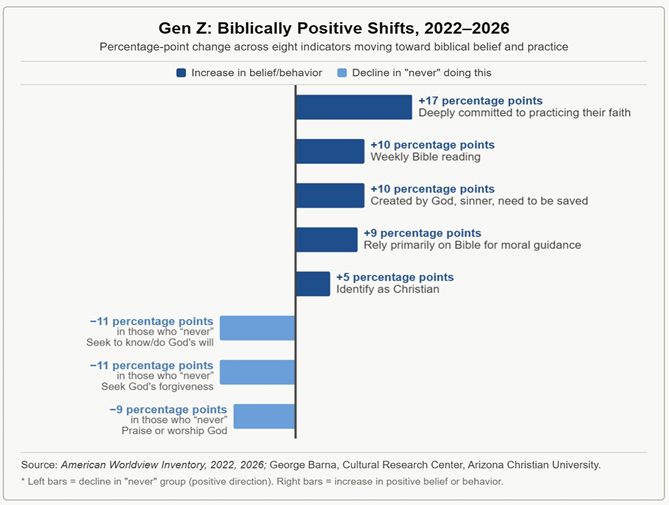
- More young adults are exploring faith, with increases in Bible reading, church attendance and identifying as Christian
- Core beliefs remain largely unchanged, with just 1% holding a fully biblical worldview
- Australian research shows a similar pattern, with young people open to faith but still forming their beliefs
Something is shifting among the youngest adult generation, but it’s not as straightforward as it first appears.
A new report from the Cultural Research Center at Arizona Christian University found that young people in Amercia aged 18 to 23 are moving in two spiritual directions at once, showing increased interest in faith while also drifting away from key beliefs.
On one hand, there are clear signs of growth.
More young adults are calling themselves Christian, Bible reading has increased, and a growing number say they are committed to practising their faith.
On the other hand, deeper beliefs remain largely unchanged. The study found that just 1% of this generation holds a fully developed biblical worldview.
Activity is rising, but foundations are not
The data highlights a gap between behaviour and belief. Increases in church involvement and Bible reading suggest openness and curiosity. Yet when it comes to core questions about truth, God and morality, most views have stayed the same.
Researcher George Barna described the findings as only “a lukewarm affirmation of revival”, noting that spiritual activity alone does not necessarily lead to lasting change. That distinction matters.
As the report explains, behaviour can spark interest, but without understanding, it often doesn’t take root over time.
The same pattern is emerging in Australia
While the study focuses on the United States, recent Australian research suggests a very similar trend among young people here.
The 2025 McCrindle report An Undercurrent of Faith, based on national census data and a survey of more than 3,000 Australians, found that the country’s relationship with Christianity is increasingly complex.
On one hand, many young Australians are moving away from organised religion. Between 2016 and 2021, more than one in three young people aged 15 to 24 shifted from Christianity to “no religion”.
At the same time, the report highlights a strong sense of openness and searching.
Young Australians are described as being on a “quest for meaning”, with more than half open to spiritual conversations and exploring belief for themselves.
Fewer, but more committed
Perhaps the most striking similarity is what happens among those who do engage with faith.
Even as overall identification declines, young Australians who are Christian tend to be more active than older believers.
Around 68% of Gen Z Christians attend church at least monthly, significantly higher than older generations.
This reflects a broader shift away from cultural or inherited religion, toward something more personal and intentional.
Open, but still searching
Taken together, the findings from both the US and Australia point to a generation that is not disengaged, but still exploring.
Young people today are less likely to inherit faith by default, but more likely to question, examine and search for meaning on their own terms.
That creates both a challenge and an opportunity.
Interest is there. Curiosity is real. But without deeper understanding, that interest may not translate into long-term change.
This article was researched and prepared by Hope 103.2 staff writers, with assistance from AI in its presentation. Final review and fact-checking was undertaken by our Digital Team prior to publication.
Feature image: Canva Pro
Get daily encouragement delivered straight to your inbox
Writers from our Real Hope community offer valuable wisdom and insights based on their own experiences!
Subscribe + stay connected with all
our latest stories
More from Christian Living